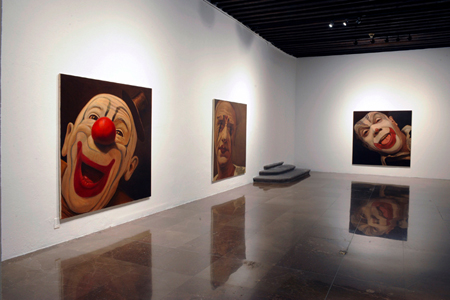
101 Tokyo

April 10th, 2009

I just returned from Japan, where I traveled to participate in a program of the 101 Tokyo Contemporary Art Fair. It was a short but intense trip, and got a chance to make multiple site visits to galleries and museums in Tokyo, plus do some sightseeing around town. The gallery Take Ninagawa held the first solo exhibition of the young sculptor Yuuki Matsumura, an artist schooled in Kyoto, whose sculptures made of broken, crashed or crumpled materials are simulacrums of minor disasters and common figures. This gallery, which was founded only a year ago, is one of the notable emerging commercial galleries in Tokyo. Other galleries founded in recent years by a young generation of art dealers, and which I sadly didn’t get to visit, are Misako & Rosen and Arataniurano.

The Mori Art Museum was exhibiting an elegantly installed showcase of works from the Thyssen-Bornemisza art collection, and the Museum of Contemporary Art a minimal yet stunning exhibition of media artist Ryoji Ikeda. Also elegant were the museum’s collection galleries—and, to my surprise and great delight, with works that had little if nothing to do with new media art and with just a few examples rubbing off anime or manga. There are big names and big works in the collection, from local and international artists alike. I was more drawn to discrete works by Japanese artists. Collection highlights include an ample set of like color-book drawings by Shinro Ohtake, a series of almost monochromatic landscape photographs by Naoki Ishikawa, and a conceptualist instruction-based work made into a multi-channel video and sound installation by Koki Tanaka.

The Japan Times journalist Donald Eubank was the organizer of the series of public programs for the 101 Tokyo Contemporary Art Fair. The topic of the panel discussion I participated in centered on the discursive support to the arts, or lack thereof, particularly in Tokyo. Issues around the local production (and export) of cultural identity, arts education and scholarly publications and public programming were addressed in what turned out to be a lively discussion. Panelists included Doryun Chong, curator at the Walker Art Center in Minneapolis; Mami Kataoka, senior curator at the Mori Art Museum in Tokyo and international curator at the Hayward Gallery in London; Yichiro Kurata, president of Shinwa Art Auction Company in Japan; Yusaka Imamura, director of Tokyo Wonder Site; and myself. The panel moderator was Tokyo-based art critic Andrew Maerkle, author of the incisive introduction to the Japanese art scene for the 2009 Almanac of ArtAsiaPacific magazine.

In it’s second version, 101 Tokyo Contemporary Art Fair was quite small, with around 20 Japanese galleries and less than 10 international more as exhibitors. It also had a project space featuring an exhibition of artworks by local artists and from abroad on loan by another group of select galleries. A thoughtfully designed space and with a strong backing of sponsors, the fair has potential. Because it’s specific to contemporary art—even if some galleries included did not display the most qualitative—it competes only minimally with the couple-years-older and more established art fair, Art Fair Tokyo. This other fair, which ran concurrently last weekend, combines modern and contemporary art galleries with businesses of traditional arts and artifacts, such as nihonga. In principle, I find interesting the idea of combining different traditions and historical periods under one roof, but less so if it’s spatially organized in a separatist standard manner. Anyway, on Sunday, in the plaza separating Art Fair Tokyo’s main venue to its hall of younger galleries, there was a great flea market, showcasing primarily twentieth century domestic items and decorations of colonial times, old Western art books, Japanese traditional cloths and clothing, and native religious artifacts. This roving collection of images and things was another engaging viewing and eclectic shopping experience.

The other Tom Cruz

March 30th, 2009

Joseph del Pesco recently invited me to participate in Artists Space’s Webcast, a curatorial initiative for making internet- and computer-based cultural content. For this, he invites artists, designers and other curators to participate in two kinds of platforms: one is Typecast, in which new typefaces are commissioned and made available for free (there are five to date, including a beautiful design by Mungo Thompson); the second one is the self-explanatory Youtube Commentary, for which voice-overs are made for videos drawn from this ever-growing online collection. My contribution was in this latter platform. I selected a video clip from P.T. Anderson’s Magnolia, and took it as an excuse to speak about Tom Cruise, as a scene to reflect on fan culture, and simply as a moment to consider degrees of insanity, all of which are embedded on Youtube.

Buying the Empire State Building and a brownstone in Brooklyn

March 17th, 2009

Today, The New York Times reported on what is likely one of the most creative fundraising efforts that the Queens Museum of Art has ever done—and a form of fundraising that will surely become more prevalent. The museum launched an “Adopt-a-Building” program using The Panorama of the City of New York. For those who’ve yet to visit the museum, its Panorama is an architectural model including every single building constructed before 1992 in Manhattan, Brooklyn, The Bronx, Queens and Staten Island. There are almost a million structures. How can this be possible? It’s simply huge. The area dimension of the model is 9,335 square foot; that’s 2,845 meters.

Now, to the gist of the program: the Adopt-a-Building initiative invites people to “invest” in the museum by playing real estate. Some pointers: loans don’t apply, so foreclosures need not be suffered; part of the funds raised go to the museum endowment and capital campaign, parts get re-invested in the model; and so on. This is sort of how The Panorama market looks like:

For $50, “purchase” your apartment. For $500, “name” your school, library or firehouse. Real Estate tycoons may donate up to $10,000, to “own” a landmark building or fund a significant update of the model.

(The quotes are theirs, to remind the speculator that this is just that, real money on hypothetical property; to remind that this is something like a gift economy in role play.)

The infamous Robert Moses—whose work on parks and recreations was in fact explored by the Queens Museum through a critical three-part exhibition they co-organized not too long ago—commissioned The Panorama in the early 1960s. It was rumored to be his working model of the city, but on paper it was made as a piece on display in the 1964 World’s Fair, which took place in Flushing Meadows-Corona Park (again, at Moses baton). The Panorama is now part of the collection of the Queens Museum, which is located in a former fair pavilion at this park.

In the last couple of decades, the museum has commissioned several people to activate The Panorama. For example, the original model makers, Lester Associates, updated the model in the early 1990s. Around that time, architect Roberto Viñoli designed the gallery where it is displayed, to be specific, the model’s platform and surrounding multi-level ramp. A sound and light show was most recently added to the room, a piece scripted by The Panorama expert Blagovesta Momchedjikova. (I am not a fan of this multi-media component. It was incorporated only a couple of years ago, and already looks and feels dated, unlike the model itself.) Visual artists have also created temporary site-specific work in The Panorama. In 2002, visual artist Michael Rakowitz used the model to identify the film locations of popular New York City films—Woody Allen’s Manhattan, Spike Lee’s Do The Right Thing, Mike Nichols’ Working Girl, etcetera. Miniature video cameras placed on the film locations (on the model) were connected to television monitors (on the ramp) transmitting live video-feed. These close-up static images of The Panorama street corners or buildings were dubbed with the original movie soundtracks.  These are only a handful of examples in which the museum has dealt with conservation, interpretation and public engagement of The Panorama. And this does not even consider the countless docent tours and regular civic-minded and aficionado programs.

While the Queens Museum Adopt-a-Building program is a fundraising initiative, it has the potential of becoming quite an experimental economic cultural project on its own. I imagine this as I contemplate some of the challenges that the initiative may encounter. From what I can project, it seems to raise only interesting questions, whether these are about technical issues (Can membership sustainability be modeled on property taxation?) or more philosophical ones (How do public museums develop the so-called American Dream of private property?). My fascination with the program also lies in its curatorial edge: it seems to be conceived by approaching a work, and imagining its public—what are we looking at, and how can we present it so the public can become part of its history and potential. In the case of the Adopt-a-Building, the museum proposes that one way this can happen is by literally (i.e. financially) investing in and within a piece of the model. I am curious to see what happens.

* * *

As a side, I wanted to note that today the Times also reported on a proposed legislature bill to prevent museums in the state from deaccessioning artworks to cover operating expenses—no doubt the most questionable form of fundraising. The economic recession has obviously put art and cultural institutions in a difficult position. And so, the shrinking art markets, endowments and sponsorships are of concern. While I think the Queens Museum has a unique fundraising program, I recognize it’s such because of the particularities of The Panorama. I do believe, however, that one can generally “model” a fundraising campaign upon anything. But for it to be creative and meaningful, it has to methodically, thematically or even structurally approach existing resources.

A couple of other interesting development programs in New York museums are the current ‘station domination’ of the Museum of Modern Art (MoMA) and the ‘chocolate bar’ of the New Museum. Even if these have less of head in creative fundraising than in strategic marketing, they are quite noteworthy. The MoMA has a temporary exhibition throughout the many platforms of the Atlantic Pacific subway and commuter train station. The project runs from February 10-March 15, 2009, and is made by the museum as “a gift” (their word) to busy New Yorkers and commuters. It includes seminal artworks in the collection reproduced in decals and prints for light-boxes; it also includes posters and signage promoting discounted membership fees. This concept of station domination –when a single buyer purchases all advertising space in a subway station—is pretty intense. It makes the site into their venue. And knowingly, the museum calls this project its MoMA Atlantic Pacific site; it has even stamped the station’s entrance and exit turnstiles.

The New Museum’s “New Chocolate Bar” is radically more downscale and intimate. As you may imagine, purchasing the chocolate comes with museum membership. The idea is drawn from the fiction film Willy Wonka & The Chocolate Factory, whereby the owner of the chocolate factory creates a playful scheme to identify his corporation’s inheritor. The scheme consists in secretly packing a select number of chocolate bars with a prize. In Willy Wonka, the prized holders get a tour of the factory, and then one of them is selected as the inheritor to the corporation, which is in good standing and desirable and all that of course. In case of the “New Chocolate Bar,” there is only one part to the award, a membership upgrade, and while it’s better than a museum tour it’s far from inheriting the institution!

Above, picture of The Panorama’s Midtown Manhattan, drawn from the Queens Museum website.

For your face

March 12th, 2009

My first l.a.Eyeworks’ frames were called Cheeks. These were thin and geometric, in aluminum red. Its surface slightly changing colors depending on light, discretely iridescent, just like a can of Coca-Cola. They looked… tasty. I was introduced to l.a.Eyeworks and their Cheeks by Alex Gray, who was my supervisor (and early mentor) during a summer internship at ArtPace in San Antonio, Texas. Cheeks were difficult to wear. They were, literally, in your face. And weird. But he convinced me. That was ten years ago.

It was a nice surprise to learn that visual artist Emily Roydson, who I worked with another summer, the one of 2004, just made a pair of l.a.Eyeworks frames. Titled Surprise… you’re pregnant!, Emily considers them a conversation piece: “Making the gaze manifest, the person wearing this work has their perspective elaborated for all to see. Provoking conversations about gender and recognition, objecthood and form, dominance and self-possession, the piece elicits a revisioning of how we read and approach each other.”

l.a.Eyeworks was established in 1979 by Gai Gherardi and Barbara McReynolds, who remain the primary creators of these handcrafted designs. Not long after their start, their frames became ubiquitous stylizing props in movies and music videos – and their stores have served as film locations, too. Not surprisingly, they’re also close to the art world, starting with their ad campaign launched in 1981 in Andy Warhol’s Interview magazine.

Oh, and about Alex. He eventually moved to New York, where he opened his own art gallery: Alexander Gray Associates. He represents artists that emerged in the seventies, eighties and nineties and that were, for some time, for many reasons, largely left unattended by the marketplace. The exhibition program is strong. And he’s never been more convincing. His upcoming exhibition centers on early and current work by one New York’s best artists: Paul Ramirez Jonas.

Image: Emily Roydson, in collaboration with l.a.Eyeworks, Surprise… you’re pregnant! (2007-2009), acetate.

Mesmerized

March 9th, 2009

Some weeks ago, Manhattan saw the arrival of Hypnotic Show, one of Raimundas Malasauskas’ latest curatorial projects and certainly one of his most mesmerizing. The inaugural Hypnotic Show took place last year at Silverman Gallery in San Francisco. I experienced its second iteration, which took place at Artists Space in New York.

Technically speaking, there are differences between mesmerizing and the practice of hypnotizing. But in today’s vernacular these terms are used inter-changeably. The first term derives from the name of Dr. Franz Anton Mesmer (1734-1815), who is known as a predecessor of hypnotism. Working primarily in Paris, his used magnets for curing, and his trance, which is referred since as mesmerism, were based on some kind of universal magnetic fluid that, according to him, existed between people and was bound to gravity. This idea was highly debated during his lifetime.

By the nineteenth century, when the word hypnosis became current, the medical study of trance shifted to a study in psychology and away from physics. Hypnosis was used to study a patient’s physical and mental response while asleep. Some of the more successful experiments of deep trance are attributed to the late work of Dr. Jean-Martin Charcot (1825-1893) in his research of neurosis and hysteria. After some period of questioning and debunking, it was in the twentieth century, particularly after World War II, that hypnosis was again embraced by the medical community, not surprisingly, by military doctors.

While there were many other practicioners of mesmerism, hypnosis and other forms of trance, it was Mesmer and Charcot’s peculiar medical practices that the popular image of the hypnotic séance is modeled from. The showmanship around hypnosis, however, has increasingly grown since Mesmer’s times. It is the dependence, the interest-filled and willing submission, really, of the patient to the hypnotizer that is raised to the level of awe or spectacle.

For Hypnotic Show, Raimundas commissioned several artists to create immaterial artworks to be tangibly experienced under hypnosis. While only a couple of contributions are drawings or images, the main submissions are succinctly drafted text pieces. These are descriptive texts detailing encounters with phenomena and art, written as instructive walks or detailed travels. The hypnotized wanderer enters in and out of scenes, encountering images, objects, and situations of different kinds. Like in dream state, many times these encounters suggest the hypnotized to define or name things, even on occasions to take authorship of certain artworks or moments that they come across.

This is how you begin to experience Deric Carner’s artwork: You are walking down a path. You are watching where you place your feet. There are loose rocks. You are surrounded by vegetation. It’s dark and dusty. The work continues until you recognize an object that is mysteriously rising from the horizon but that is, you think, quite clearly not the sun. The hypnotizer then transitions to another work, the contribution by Will Holder. This time you encounter an image of Elvis Presley. A poster that becomes three-dimensional. You find yourself interacting with Elvis.

These are only two of more than a dozen artworks commissioned by Raimundas, who hands the exhibition as script to a professional hypnotizer, Marcos Lutyens. To experience the exhibition, then, the public convenes at a gallery for the séance. In the backdrop, a video by Patrizio di Massimo rendered a seal in fade-ins and close-ups. In the foreground, the curator and hypnotizer lead the event. At Artists Space, there were about ten people who volunteered for hypnosis; they were in fact audience of the exhibition. The rest of us there, the majority, were merely spectators bearing witness to their experience. And while not in a state of trance, at least imagining what it could feel to be in that place.

In the press release—a document written as a responded list of Frequently Asked Questions—the curator described this unconventional and allegedly immaterial exhibition as “a temporary social structure for engaging into creative cognitive acts through shared practices of art and hypnosis.” At the end of the séance at Artists Space, Raimundas explained that he sought to place an exhibition in the brain. The weight given to physical site is interesting. It opened a discussion that is less about memory or imagination, than about sense and sensibility, or as he suggested, of neurology.

In a valley of sugar cane

February 2nd, 2009

The windows quaked. Car alarms triggered. My heartbeat rises, and body shivers. The image on TV has suddenly changed to snow. I’m in the equatorial zone, and assume the roar is thunder announcing the start of a tropical storm. But now the sound is not of wind but of helicopter wings. I peek out and see. The clouds are made of smoke.

That thing I heard was a rumble from a bomb. There’s a building crumbled to the ground.

I am only in the fourth floor. I think. Blink. I chose to take the stairs. And there we are, the only handful of its guests of this almost empty hundreds-room hotel. Just there, standing in a high-ceiling lobby furnished in the fifties clinging to its forgotten grandeur with nostalgia. Us, in a rundown-downtown, now with chaos all around.

Earlier at the airport, I thought I’d missed the flight. Far from sweet is this evening in the valley of sugar cane.

Image: Pasado mañana (2008) by Judi Werthein, installation view at “Urgente! 41 Salon Nacional de Artistas” in Cali, Colombia.

From one gallery to another

January 14th, 2009

In the following interview, the emerging curator Emilie Villez discusses the formation and recent work of the Parisian curatorial collective, Le Bureau/, and about the burgeoning French Association for Curators that she was instrumental in forming with other colleagues in the field. Aside from being active in those two organizations, Emilie writes, curates independently, and works at Kadist Art Foundation in Paris.

Read the rest of this entry »

What it was. What it is.

January 8th, 2009

One of the strongest exhibitions I saw in 2008 was From One Revolution to Another, presented during the fall and winter at the Palais de Tokyo in Paris. The exhibition was part of the institution’s Carte Blanche initiative, whereby an artist is given time slot in the schedule to curate an exhibition in the entire venue. From One Revolution to Another was Jeremy Deller’s carte blanche. The exhibition took the entire venue, and consisted of large and small shows and salons, including the eclectic “Folk Archive” made together with his collaborator Alan Kane.

One of my favorite components was “1984-2008. Ed Hall. Banners” (installation view pictured here). These were dozens of banners hung through two—the most spacious—galleries of the Palais. These were beautiful and attractive banners that artist and activist Ed Hall created for “organizations committed to social and political causes.” Hall selected the banners on display, which are on loan by their respective groups represented, and also made a banner for the Palais exhibition.

If this was one of the strongest exhibitions in my mind, the reason was proportion. And I do not mean the size of the venue or the scale of the work — two much-heard criticisms about recent exhibitions at the Palais. By proportions I mean to point to the social dimensions that the project embraced. The exhibitions that made From One Revolution to Another presented recent movements, from craft to politics, that create new communities and shape the cultural landscape of Britain and other nations.

This year, Deller got his carte blanche in the US for which he creates It is what it is: Conversations about Iraq, co-commissioned and presented by the New Museum and Creative Time. The project starts next month with programming in New York, and then extends nationwide as a cross-country tour. It’s curated by Laura Hoptman, Amy Mackie and Nato Thompson, with research by Shane Brennan, Sarah Demeuse, Ozge Ersoy, Jazmin Garcia, and Terri C. Smith.

Making time for boredom

November 29th, 2008

This is the fourth and final video documenting the events organized in conjunction to the exhibition Archaeology of Longing at Kadist Art Foundation in Paris. I’ll continue making videos for Sideshows, but probably less regularly. Anyway, the video here shows excerpts from a lecture on boredom conducted by Lars Svendsen. The video is less than ten minutes, so it’s really just a fragment of an hours-long program, including a Q&A session with the public, which was interesting if a bit contentious—the lack of a psychoanalytic approach in his presentation was questioned. Lars’ response, “I don’t trust Freud.”

Indeed, in his book, A Philosophy of Boredom, Lars does not approach boredom with a psychoanalytic eye. Yet, while his exploratory investigation is not a psychoanalytic in a materialist sense, it still combines research drawn from the history of ideas to popular culture. It looks at boredom from many different sides, and, in its mix of philosophical references to literature to music, it succeeds in introducing one to the complexity that is, what the author deems, a modern condition of humankind. The book is organized in four sections—the problem, the stories, the phenomenology and the ethics of boredom. The video here combines at least a reference to the first two parts, including a brief mention of the typologies of boredom, and a bit of the importance around boredom and the making, or lack thereof, of meaning.

It was Tom Cruz who pointed me to Lars’ book, which he had reviewed for a journal some years ago. We took it upon ourselves to also analyze some of the works Lars had mentioned there, Crash and American Psycho among them. One piece that made a significant impact on me was Alberto Moravia’s Boredom from 1960. In this novel, Dino, a young, aristocrat painter can own anything except what he thinks is the genuine love from his disaffected model and lover. The search for meaning and impossibility of possessing certain things, which Dino represents, are the very characteristics of boredom.

In Archaeology of Longing, displayed were several copies of Moravia’s novel in different translations: a copy in the Italian, La Noia; in French L’ennui; the first English edition called The Empty Canvas and the most recent simply titled Boredom. The idea was not only to declare object as source in the exhibition. It was also to suggest that each translation offered a new interpretation.

The lecture “A Philosophy on Boredom” by Lars Svendsen took place on the afternoon of November 1, 2008 at Kadist Art Foundation in Paris, France. The book, “A Philosophy on Boredom,” was originally published in Norway in 1999; its first English translation was published in 2004 by Reaktion Books.

What does it take to make an alternative?

November 14th, 2008

Originally in French, Gustave Affeulpin’s The so-called utopia of the centre beaubourg (1976) is a fictional report on the construction and operations of an art center underneath the Centre Georges Pompidou in Paris, France. Built in tandem with the museum that is internationally known as the “Pompidou”—native Parisians mostly refer to it simply as “Beaubourg”—the underground center that Affeulpin describes is not a copy but a double. Decidedly, not mimicking. Instead, co-existing. To present culture in its most incisive form, the infrastructure and organizing principles of this, the other center, must be collectively decided upon its public and its program progressively unfold in time, at the vision and inertia, so to say, of its constituents. Affeulpin uses the pseudonym “Albert Meister” to write a piece of fiction as a documentary account. The book is a vivid report on the life of a cultural place, and the inner-workings and mostly failings of an endeavor closer to a utopia blueprint than a concrete place.

The English translation of The so-called utopia of the centre beaubourg, this version subtitled with the tag-line “An Interpretation,” was done by visual artist Luca Frei. Luca’s version includes notes and images, in-between lines and as illustrations, on the construction of the Pompidou and the first publication of Affeulpin’s book. And, as the subtitle he tags on to the original suggests, his is not a straight transliteration of a text from one language to another. The published work claims to be a new work. Intentionality here is crucial. While the book remains a work by Affeulpin, its current manifestation—in English, in print, in distribution and discussion—is made by Luca, highlighting while raising a bit of speculation around appropriation, literary, and citationality, literally.

The so-called utopia of the centre beaubourg – An interpretation was co-published in 2007 by Book Works and CASCO, Office for Art, Theory and Design, Utrecht. The video here documents Luca Frei reading selected passages in the book, a program held on September 18, 2008 in conjunction to the Archaeology of Longing at Kadist Art Foundation in Paris.